Navigating the Future
An Interview with Kara C Cunzeman, Director of Strategic Foresight at The Aerospace Corporation
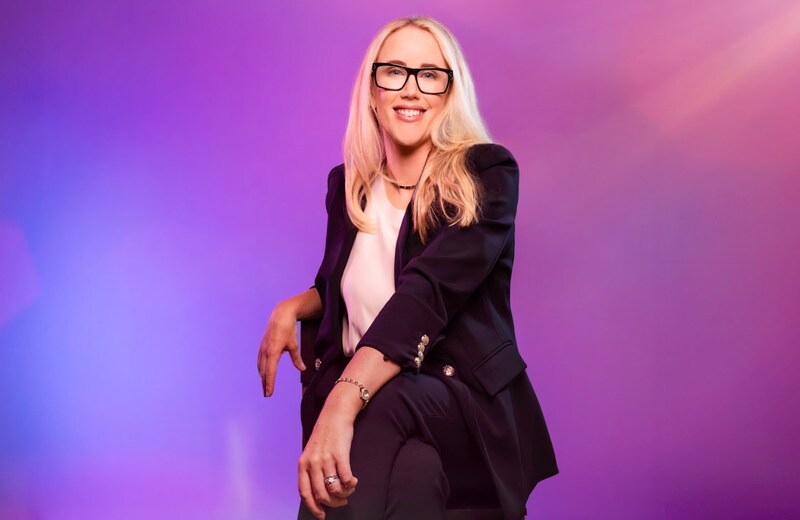 Kara C Cunzeman leads strategic foresight at The Aerospace Corporation, a federally funded research center focused on space. Based in Washington, DC, she's built her career on challenging conventional thinking about the future while fighting what she calls "bureaucracy for a living." Her approach to innovation combines rigorous futures thinking with speculative design, bringing together rocket scientists, political scientists, and artists to envision bold new possibilities for space exploration. In this conversation, Kara shares how her team generates breakthrough ideas, why teenagers make the best trend spotters, and why innovation can't flourish in an environment of fear.
1. What does innovation mean to you?
Innovation is really a mindset. It's about bringing bigger, bolder ideas to the status quo to change the world for the better.
2. How does your team generate new ideas?
A good foundation is a strong team. I'm very fortunate in that I've built my team from the ground up, so I got to handpick all of my talent. I think a big part of innovation is actually the people that you have as part of the process.
I have a very diverse team with various disciplines and practices. Obviously, I work in a very technical field as a rocket scientist and in futures, so we have some of those -- we have systems engineers -- but we also have people in political science. I actually have a woman on my team who's an incredible speculative design artist, and she worked on things like the Tom Cruise movie Minority Report from the '90s.
But we're also very rigorous in our practice, and I think time is absolutely essential for good, solid innovation. It's not predictable. It's not this deterministic linear process. You have to give yourselves time to connect, time to riff, time to think deeply about what actually is purpose-driven. I think a lot of times we hear about innovation theater, and I think a big part of why we have innovation theater is because we don't understand what problems we're actually trying to solve. I think that's one of the biggest parts of the process of innovation.
And then thinking about how you come up with good ideas -- you have to be inspired. I think you have to connect with others, and usually what we find is our best ideas are riffs off of each other over time. It's never like that first idea. You kind of get worn down, right? It takes a lot of brainpower and thinking, but the more you riff off of each other, it's usually that last iteration—right before you give up—that's actually the really good piece.
And then sometimes coming back to it. Some great ideas, it's just not the right time, or you're ahead of your time. You put them on the shelf, and then you come back to them and the timing's right. So it's also about this never-ending practice of creating this innovation library that you can kind of pull and piece apart and reinvent as a team when you come back to it.
3. Do you have any specific rituals for resetting your team to be creative?
For me, I am really into music. I feel like music just changes the vibe. I actually, when I studied in college, listened to a lot of electronica. I felt like it's not too distracting -- I mean, some people might find it distracting -- but you have that steady beat that kind of keeps you going. Usually when we do workshops, we bring in music. I think it just adds a really nice element to uplift and change the vibes in the room.
I think if you really have a big, different kind of concept, change the space. Go somewhere different, go somewhere outside, off-site. Change the space and it totally just brings a different, fresh environment for the people who are going to be there.
And then I think lots of ability to create. If you're all on your computer -- which I feel like is the tendency with AI nowadays -- make a two-hour, no-computer rule. We're just going to whiteboard this, or we're just going to build stuff. Throw a bunch of stuff on the table and say we're going to prototype this in real life.
Many of us learn differently. I personally, to remember things, have to write things down. I'm very visual, and for me, I can do it online in Miro or Canva or whatever, but it's much more interactive when you're on a whiteboard together. I think that physical, actual, in-real-life creation is just as important as sitting in front of each other with computers.
4. How are you leveraging AI in your innovation process? What are some unexpected benefits or challenges you've encountered with AI adoption?
I don't think AI is detrimental to innovation at all. Actually, it can be detrimental to the human creative process if it's not managed well.
For our team, especially because I work more on the futures aspect -- trying to define where the future's going, what hard problems actually need to be solved—we do a lot of our initial thinking independently from the tech. And then we engage and we ask, "OK, so if I pull this thread, what are the implications? Give me something surprising. How would I solve this problem?"
And then we come back and we say, "OK, but what are the most critical uncertainties about those future states?" And usually AI doesn't usually get those right. It's just pulling generically. That's the most important part -- our team will spend a day or two riffing off the really most critical uncertainties driving this future, and that is a very human-centric piece. But then the scenario writing -- we give it all the details, and it can pump out a pretty decent first draft. So that's really accelerated our work.
And then my favorite part of it is actually prototyping the future. You can now create visuals and videos about all the content literally in real time in workshops, and it just brings people alive. It brings such satisfaction. They're excited, they're bringing something new, and that new thing is created in real time. It's very energizing.
The unexpected challenge? I've been quite frankly disappointed in AI's application to horizon scanning versus scenarios and video. The horizon scanning piece -- we personally haven't seen as much progress as we'd like.
5. How do you identify trends? What resources does your team use to spot trends and consumer insights?
We are using agents now to help us look for trends, but I'll be honest -- it's been mixed results. It's really hard to physically go build a scraper and look at every little facet of the internet. But honestly, a lot of these models aren't looking at every facet of the internet. They're looking at 10 or 15 of the big sites and then going and sourcing extra if they need it.
A lot of our homegrown trends and emerging signals analysis is because of what people bring to the table as a whole person. Maybe they're a rocket scientist by day, but they're also really interested in the arts. They have teenage kids who are always bringing home the best signals, by the way. The teenagers bring the best signals.
So we have a very human-first approach to signals analysis, because what's on the internet is what everybody knows. Some of it's right, and some of it -- there's a lot of bias in that. I still think right now, with where tech is, it can be helpful, it can give you new ideas, but it can also give you too much data. Is all of this actually really that important? Are those trends real? Because there's a lot of data out there, and is that data actually real or accurate for where we are today?
6. What is the biggest challenge you face when innovating?
It's getting our decision makers to take the big bets that need to happen for transformational change in an environment where they're not incentivized to do so. I basically say I fight bureaucracy for a living, and it is no joke the hardest part of my job.
Rocket science isn't the hardest part of my job. Innovation isn't thinking about the future and what the future's going to look like. It's managing systematic change in a meaningful way, in a timely way. And it's becoming even more important in this environment we're in, but also harder.
7. Has there ever been an instance where another industry has influenced an innovation at The Aerospace Corporation?
Space has influenced a lot of industries just with its developments, but it's also being influenced by what we'll call adjacent industries. I'm thinking about architecture. There's a company called Aurelia Institute that is working on basically building magnet tiles for space -- kind of like the magnet tiles that kids play with. They put all the tiles out, and they go together, and so you can create these artificial habitats basically anywhere in orbit.
I just think that's such a great example. You don't have to have an astronaut out there soldering. It can be put up, put down, augmented, changed. I think just looking for inspiration everywhere is really interesting, and I think space is going to see a lot more of this because there's just a lot more players. There's non-traditional players. A lot of our billionaires have really gotten into space. Basically, Sam Altman even wants to get into space.
So I think there's going to be a lot of really interesting intersection points. Even fashion -- we've seen Prada building a spacesuit. We've seen Hilton baking cookies in space. I think there's going to be a lot of really interesting pop culture, tech-adjacent activities that are happening in the future.
8. What makes an innovative culture? How do you create a culture of innovation?
Innovation can't happen in an environment of fear, and there's a lot of fear and apprehension right now—both budgetary, but also for people's livelihoods and well-being with what's happening in AI. There's so much uncertainty.
When I step back and look at innovation ecosystems, that's probably what I'm most concerned about right now. People are walking around in fear, and innovation just doesn't happen that way. You need to create places of trust, and you need to create places of hope and aspiration for the future.
At the end of the day, the formula for culture is good leaders and good incentives. I think a lot of places have it wrong. I think we're all incentivized by quarterly earnings -- what do I need to do to check that box to move up for my personal career? We don't treat it like the truly collective, collaborative initiative that it is.
9. Looking to the future, how will The Aerospace Corporation continue to be a leader in innovation?
I've recently had the opportunity to step back and look at probably the last 10 years or so of my career, which was not planned. I think most innovators say that, and I'm actually a professional planner, right? I'm a futurist. I think about the future, we set plans, we create strategies, we integrate. But I've kind of learned how to just go with the flow and have that vision -- be really strong on the vision and the principles that you live by, but be highly flexible. Be awake. New opportunities are a conversation away, a conference away. Just be open and flexible and take advantage of that.
I think it's that balance between agility and adaptability, but also being really firm about the core principles that you work off of. Teamwork makes the dream work, and I really do believe that good futures work, good innovation work, is all about the team. So how do you bring the A-game of everybody on your team to your activity?
And then as a leader, I'm looking to overcome that hard part: How do we get our decision makers to seed deep, bold transformation in the future? That's what my eye is on pretty much for the foreseeable future.
References: aerospace.org