Trend Hunter’s Six Patterns of Opportunity: Reduction
Related Trend Reports
Tech, Lifestyle, Health, Customization, Fashion, Eco, Underwear, Social Business


In a world of constant complexity, innovation isn’t always about adding more, sometimes it’s about removing what isn’t essential. Simplicity, specialization, and focus have become competitive advantages.
Trend Hunter’s innovation methodology is built on two foundational frameworks: the 6 Patterns of Opportunity and our 18 Megatrends. The Patterns ( Acceleration, Cyclicality, Redirection, Reduction, Convergence, and Divergence) represent six repeatable pathways organizations use to drive meaningful innovation, shaped by decades of research and conversations with the world’s most forward-thinking leaders. Each Pattern aligns with three Megatrends, linking innovation action to the consumer motivations that create lasting impact.
In this article, we’ll explore Reduction, the opportunity to innovate by simplifying, curating, and honing in on what matters most.

What Is Reduction?
In business, innovation is often mistaken for expansion: More features. More offerings. More channels. More complexity.
But consumers don’t always want more; they want better. Reduction is the Pattern of Opportunity rooted in the philosophy that less is more. It uses exclusion as a tool, stripping away the unnecessary in order to amplify what is most valuable.
Reduction is innovation through refinement.
It asks:
- What can we remove to create more clarity?
- What can we simplify to reduce friction?
- What happens when we specialize instead of generalize?
In an overstimulated world, Reduction becomes differentiation.
Why Reduction Matters Now
Modern consumers are overwhelmed.
They face:
- endless product options
- information overload
- decision fatigue
- constant digital noise
- pressure to do everything at once
As a result, simplicity is no longer just aesthetic. It is emotional relief.
Reduction matters now because consumers increasingly reward brands that offer:
- convenience without clutter
- focus instead of fragmentation
- curated experiences instead of endless choice
- minimalism that feels intentional
In many categories, the next competitive advantage isn’t complexity. It’s clarity.
How to Use Reduction: Three Pathways to Simplify Innovation
Reduction can take many forms, but the strongest applications often fall into these approaches:
1. Simplify a product or service
The most direct form of Reduction is removing friction. Simplification creates accessibility, speed, and ease in categories where consumers feel overwhelmed.
Ask: What could we make easier immediately?
2. Specialize instead of generalize
Reduction can also mean narrowing focus. Rather than trying to serve everyone, brands innovate by serving a specific need exceptionally well. Specialization creates distinctiveness through depth.
Ask: What could we own completely by doing less, better?
3. Strip an idea down to its most essential function
Reduction challenges innovation teams to identify the core purpose of an offering and eliminate everything else. Fewer layers often create more impact.
Ask: If we removed everything nonessential, what would remain?

When Should Innovation Teams Use Reduction?
Reduction is especially valuable in two strategic moments:
1. When you hear a demand for convenience
Convenience is one of the loudest consumer signals today. When consumers are stressed, busy, or overloaded, simplicity becomes a form of value. Reduction helps brands respond by removing steps, choices, or complexity.
2. When you want to alleviate the pressure to do it all
Many organizations feel pressured to expand constantly. Reduction offers an alternative: innovate through focus, curation, and restraint.
Sometimes the most strategic move is narrowing, not widening.
Baseline Questions for Reductive Innovation
When facing an innovation challenge, Reduction begins with two foundational questions:
- How can we further simplify our product or service to create even more impact?
- What is the one offering that captures the essence of our brand, and how can we strip it back to its core values?
These questions shift innovation from addition to refinement.
Classic Case Study: Morioka Shoten — A Bookstore of One Book
One of the most striking examples of Reduction is Morioka Shoten, a tiny bookstore in Tokyo built around an almost radical premise: A single room. A single book.
Rather than offering thousands of titles, Morioka Shoten sells only one book at a time; multiple copies of a single title that changes weekly. The store pairs the book with a small art exhibition inspired by its themes, creating a deeply curated, intentional experience.
In a world of endless choice, Morioka Shoten succeeds by doing the opposite:
- reducing selection
- increasing meaning
- turning limitation into allure
It proves a powerful Reduction insight: Curation can be more compelling than abundance.
Reduction and the Megatrends Behind It
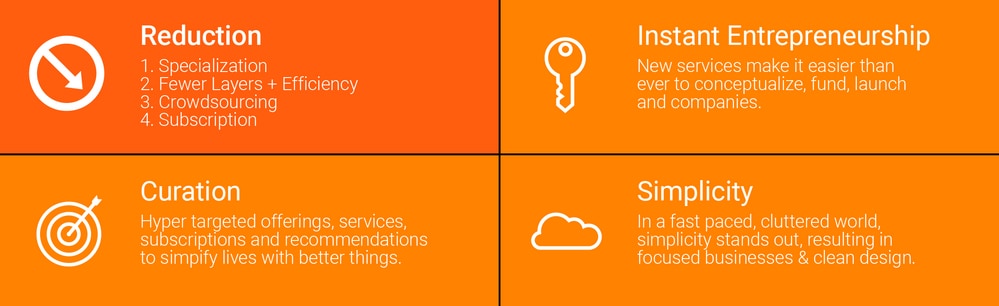
Reduction maps directly to three of Trend Hunter’s Megatrends:
- Curation: consumers seek guidance and intentional filtering in a world of excess
- Simplicity: clarity and ease are increasingly valuable emotional benefits
- Instant Entrepreneurship: streamlined, focused models enable faster creation and niche success
These Megatrends explain why Reduction resonates today: consumers want less noise, more intention, and offerings that respect their limited attention.
The Takeaway: Reduction as Strategic Innovation
Reduction reminds innovation leaders that breakthrough ideas don’t always come from adding. Sometimes they come from removing.
Reduction is a repeatable strategy for:
- simplifying complexity
- creating curated differentiation
- specializing with purpose
- delivering clarity in an overwhelmed world
In markets defined by excess, the brands that win are often those that offer restraint. When paired with Trend Hunter’s broader methodology, the Patterns of Opportunity and Megatrends, Reduction becomes more than minimalism. It becomes a strategic pathway to what’s next.
To simplify complexity and innovate through focus, curation, and clarity, explore Trend Hunter’s Patterns of Opportunity Workshop, where teams turn insight into impact.