Trend Hunter’s Six Patterns of Opportunity: Redirection


In a marketplace where consumers are constantly bombarded with options, innovation isn’t just about improving products; it’s about creating experiences that break through expectations.
Trend Hunter’s methodology helps organizations spot these opportunities through two foundational frameworks: the 6 Patterns of Opportunity and the 18 Megatrends.
The Patterns (Acceleration, Cyclicality, Redirection, Reduction, Convergence, and Divergence) serve as six strategic pathways businesses use to drive innovation, informed by thousands of conversations with category leaders and emerging disruptors. Each Pattern maps to three Megatrends, connecting innovation efforts to the consumer motivations that shape cultural change.
In this article, we’ll explore Redirection, the art of flipping expectations to create unforgettable moments of surprise and delight.

What Is Redirection?
Most brands compete by meeting expectations. Redirection wins by rewriting them. Redirection is a Pattern of Opportunity that starts with a familiar consumer assumption, then flips it on its head to deliver an entirely new, memorable experience. It’s innovation through contrast:
- taking a routine and making it remarkable
- turning a predictable journey into a surprise
- shifting attention toward something unexpected
- transforming functional interactions into emotional moments
At its core, Redirection is about reimagining the consumer experience by asking:
What if we did the opposite of what people expect? In a world where sameness is everywhere, Redirection creates standout relevance through disruption, not disruption for its own sake, but disruption that delights.
Why Redirection Matters Now
Consumers today are not just buying products. They’re buying:
- experiences
- stories
- entertainment
- identity
- emotional payoff
In many industries, the baseline has risen. Convenience is assumed. Quality is expected. Features are replicable. What differentiates brands now is not what they offer, but how it feels.
Redirection is especially powerful in an era of:
- short attention spans
- experience-driven loyalty
- social sharing and cultural virality
- consumers craving novelty within routine
In other words, Redirection is how brands create moments that people remember — and talk about.
How to Use Redirection: Four Innovation Pathways
Redirection can be applied across industries, from retail to healthcare to financial services. The strongest Redirection innovations often show up in these forms:
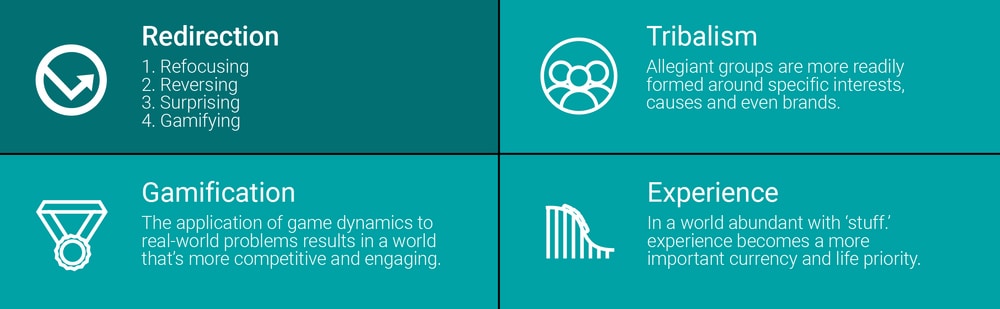
1. Refocus the consumer’s attention
Sometimes innovation isn’t about changing the product; it’s about changing what the consumer notices. Brands can redirect attention toward overlooked benefits, hidden rituals, or new emotional framing.
Ask: What part of the experience deserves more spotlight?
2. Reprioritize what matters
Redirection often involves shifting the hierarchy of value. Instead of emphasizing the obvious, brands elevate something unexpected: comfort over speed, humor over seriousness, play over productivity, etc. This is how categories evolve.
3. Surprise and delight
Redirection thrives on emotional interruption. A moment of unexpected generosity, humor, personalization, or sensory delight can turn a transaction into loyalty. Surprise is memorable because it breaks routine.
4. Gamify the experience
Gamification is a modern Redirection lever that turns everyday behaviors into engaging challenges, rewards, or playful rituals. From fitness streaks to loyalty apps, gamification redirects effort into enjoyment.
Ask: How could this feel more like a game than a task?

When Should Innovation Teams Use Redirection?
Redirection is especially valuable in two strategic situations:
1. When you’re looking to reinvent a ritual
Rituals are powerful because they’re repeated: coffee routines, skincare habits, shopping journeys, wellness practices. But repetition can also create boredom. Redirection allows brands to refresh rituals without breaking them.
Ask: What daily behavior could we make more engaging, meaningful, or unexpected?
2. When you want to build deeper loyalty
Loyalty isn’t built through satisfaction alone. It’s built through emotion. Redirection helps brands over-deliver in ways that consumers don’t anticipate, creating moments of attachment.
Ask: Where in the journey could we exceed expectations in a way competitors wouldn’t think to?
Baseline Questions for Redirective Innovation
When facing an innovation challenge, Redirection begins with two foundational questions:
- What major trends, routines, or consumer behaviors could we rechannel into new, engaging experiences?
- Where in the customer journey could we meaningfully exceed expectations?
These questions shift ideation away from incremental improvement and toward experiential transformation.
Classic Case Study: Buckley’s “It Tastes Awful. And It Works.”
Buckley’s cough syrup is one of the most iconic examples of Redirection.
In medicine, consumers expect brands to convince them that a product tastes good, feels pleasant, or goes down easily. Buckley’s did the opposite. Their message was blunt:
“It tastes awful. And it works.”
Instead of hiding the unpleasantness, they leaned into it, redirecting consumer perception. The bad taste became proof of effectiveness.
That’s Redirection in action:
- taking a negative expectation
- flipping it into a differentiator
- creating memorability through honesty and surprise
Buckley’s didn’t compete on flavor. They competed on trust, humor, and the unexpected.
Redirection and the Megatrends Behind It
Redirection maps directly to three of Trend Hunter’s Megatrends:
- Tribalism: consumers seek belonging through shared experiences and cultural moments
- Experience: value is increasingly defined by emotion, immersion, and storytelling
- Gamification: engagement rises when routines become playful and rewarding
These Megatrends explain why Redirection resonates so strongly today: it transforms the ordinary into the remarkable.
The Takeaway: Redirection as Experience-Led Innovation
Redirection reminds innovation leaders that breakthrough ideas don’t always come from invention. Sometimes they come from re-seeing. Redirection is a repeatable strategy for:
- reinventing rituals
- building emotional loyalty
- creating surprise in saturated categories
- turning routine interactions into standout experiences
In a world where consumers are overwhelmed with options, Redirection helps brands become unforgettable. When paired with Trend Hunter’s broader methodology, the Patterns of Opportunity and Megatrends, Redirection becomes more than creativity. It becomes a strategic pathway to what’s next.
To identify where your customer journey could be reimagined through surprise, delight, and experience-led innovation, learn more about Trend Hunter’s Patterns of Opportunity Workshop.