Trend Hunter’s Six Patterns of Opportunity: Cyclicality


Innovation is often associated with what’s new, but some of the most powerful opportunities come from what’s familiar. In today’s fast-changing world, consumers increasingly gravitate toward comfort, meaning, and emotional connection.
Trend Hunter’s innovation methodology is grounded in two enduring frameworks: the 6 Patterns of Opportunity and our 18 Megatrends. The Patterns (Acceleration, Cyclicality, Redirection, Reduction, Convergence, and Divergence) represent six repeatable ways organizations create meaningful innovation, shaped by decades of trend research and conversations with the world’s most forward-thinking brands. Each Pattern aligns with three Megatrends, linking innovation strategy to the deeper consumer desires that drive lasting change.
In this article, we’ll explore Cyclicality, the Pattern of Opportunity rooted in nostalgia, revisitation, and the power of return.

What Is Cyclicality?
There’s an old saying: history repeats itself. In innovation, that repetition isn’t accidental; it’s emotional. Cyclicality is the act of channeling revisitation to spark a sentimental response. It is innovation through return: reviving what once mattered, reimagining what once worked, and reconnecting consumers with experiences that feel familiar, comforting, or culturally iconic.
Cyclicality doesn’t mean copying the past. It means using the past as a foundation and modernizing it for the present. In a world defined by disruption and uncertainty, Cyclicality is a reminder that innovation can also be about rediscovery.
Why Cyclicality Matters Now
We often think of innovation as forward motion, faster technology, newer products, and constant reinvention. But consumers don’t always want “new.” Sometimes, they simply want meaning, and meaning is often tied to memory.
Cyclicality is accelerating because today’s consumers are navigating:
- rapid cultural change
- digital fatigue
- economic uncertainty
- generational identity shifts
- craving for comfort and simplicity
In moments of instability, people gravitate toward what feels emotionally grounding. Nostalgia becomes not just an aesthetic, but a coping mechanism, a cultural anchor, and a powerful business opportunity. For brands, Cyclicality offers something rare: Relevance that feels earned.
How to Use Cyclicality: Four Ways to Innovate Through Return
Cyclicality can be applied across industries, categories, and experiences. The most effective cyclical innovations often take one of these forms:
1. Use retro and nostalgia in design
From packaging to branding to product form, retro cues can instantly create an emotional connection. The goal isn’t gimmick, it’s resonance.
Ask: What design language from the past still carries meaning today?
2. Appeal to a previous target demographic
Consumers evolve. Generations shift. What once mattered to your audience may matter again, in a new life stage. Cyclicality is especially effective when brands reconnect with former loyalists.
Think: How do we reintroduce ourselves to the consumer who grew up with us?
3. Create around seasons, rituals, and cultural cycles
Cyclicality is deeply tied to the rhythms of life: holidays, festivals, annual traditions, and seasonal behaviors. Innovation teams can use these cycles as predictable moments for reinvention.
Ask: What rituals can we refresh each year to stay culturally present?
4. Revive something that worked before, with a modern twist
Some of the best innovations are revival plus relevance. Brands can bring back legacy products, formats, or ideas; updated for today’s consumer expectations.
Cyclicality is not repetition. It is reinvention through recognition.

When Should Innovation Teams & Leaders Use Cyclicality?
Cyclicality is especially powerful in three strategic situations:
1. When you want to reconnect with former loyal consumers
As generational preferences shift, brands often lose relevance. Cyclicality helps rebuild emotional connection by reminding consumers of shared history. This is especially effective for legacy brands seeking renewal.
2. When you want to showcase a milestone or brand moment
Anniversaries, awards, heritage moments, etc., these are built-in opportunities for cyclical storytelling. Rather than simply celebrating, brands can use milestones as innovation platforms. It’s about honoring a brand’s past while signaling what’s next.
3. When you want to innovate around a seasonal or cultural moment
Cyclicality thrives when paired with predictable cultural peaks: summer travel, back-to-school, holiday gifting, national celebrations, etc. Innovation leaders can create repeatable moments of anticipation.
Baseline Questions for Cyclical Innovation
When facing an innovation obstacle, Cyclicality begins with two foundational questions:
- What nostalgic trends, aesthetics, or experiences could be reimagined to inspire our next idea?
- What do consumers think about our relevance today — and how might we reposition our offerings to reach them again?
These questions shift innovation away from novelty alone and toward emotional continuity.
Classic Case Study: Pokémon Go
Pokémon Go is a defining example of Cyclicality done right. The Pokémon franchise was already iconic, deeply nostalgic for millennials who grew up collecting cards and watching the original series. But instead of simply re-releasing the past, Pokémon Go redirected nostalgia into a modern behavior: augmented reality, mobile gaming, and real-world exploration. It revived childhood identity while creating an entirely new experience, but the real key was timing. It was released in 2016, a monumental year for Millennials. Many millennials were hitting key milestones in 2016: graduating from university, starting careers, moving to new cities, or settling into adult independence. It was a time when many Millennials were craving nostalgia and escapism.
Pokémon Go succeeded because it tapped into a cyclical truth: The past becomes powerful when it’s reactivated through the present.
Cyclicality and the Megatrends Behind It
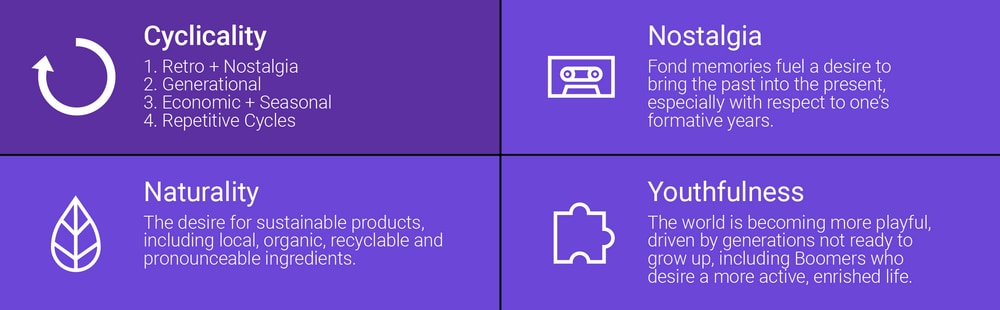
Cyclicality maps directly to three of Trend Hunter’s Megatrends:
- Nostalgia: consumers seek comfort through revisiting cultural touchstones
- Naturality: a return to simplicity, grounding, and the organic rhythms of life
- Youthfulness: the desire to preserve play, energy, and emotional connection across generations
Together, these Megatrends explain why cyclical innovation resonates: it fulfills deep consumer desires for familiarity, comfort, and timeless identity.
The Takeaway: Cyclicality as Emotional Innovation
In a marketplace obsessed with disruption, Cyclicality offers an alternative advantage: Innovation that feels emotionally inevitable.
Cyclicality is a strategy for:
- reconnecting with loyalty
- refreshing heritage without losing authenticity
- making brands feel timeless, not trendy
- creating comfort in uncertain times
The most future-ready brands aren’t always those that abandon the past; they’re the ones that know how to bring it back - with purpose. When paired with Trend Hunter’s broader methodology of Patterns and Megatrends, Cyclicality becomes more than nostalgia. It becomes a repeatable pathway to enduring relevance. Innovators should use this Pattern as a lens to view a project, obstacle, or roadblock through. When innovation becomes a priority, solutions get creative and sticky.
To apply Cyclicality and uncover emotionally resonant opportunities rooted in nostalgia and revisitation, explore Trend Hunter’s Patterns of Opportunity Workshop for hands-on innovation planning.