The Six Patterns of Opportunity: An Introduction
If you’ve worked in innovation long enough, you’ve seen the cycle: a new idea pops up, everyone races to copy it, and a year later nobody talks about it. The problem, of course, isn’t a lack of inspiration, but the decision quality. Teams need a better way to tell the difference between a one-off example and a repeatable opportunity they can actually bet on.
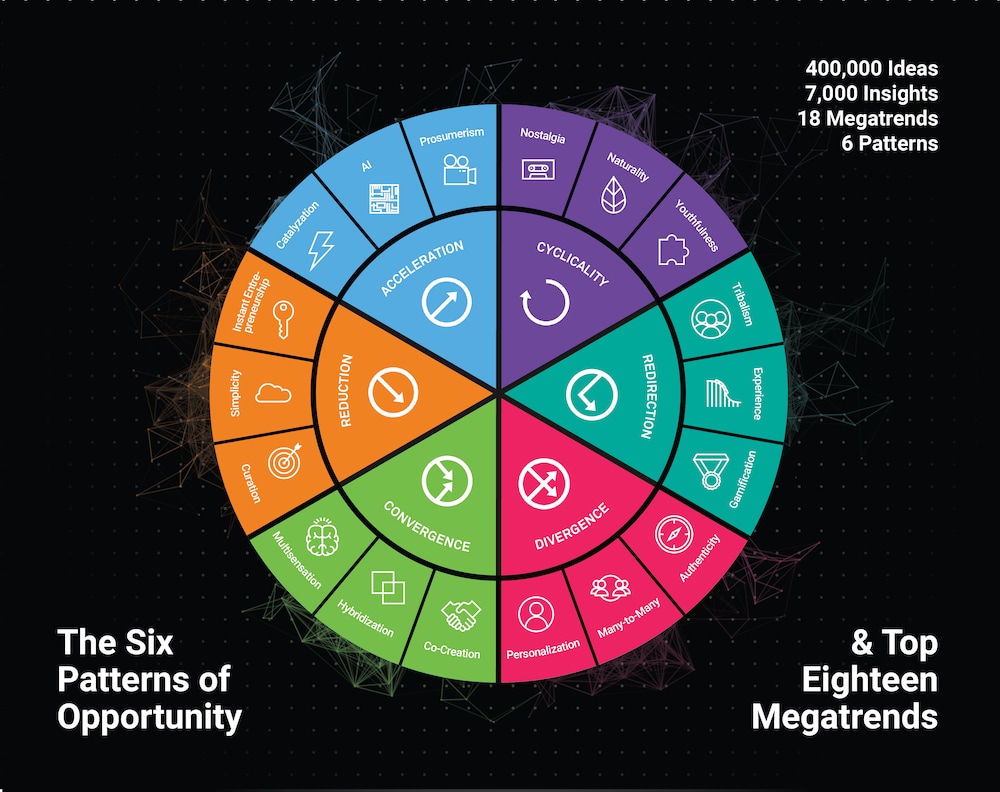
This is the problem Trend Hunter's Six Patterns of Opportunity framework was built to solve. Developed through decades of research and thousands of conversations with innovation leaders across industries, the Patterns are a practical framework for making that judgment call more rigorous and more repeatable.
The simple idea: opportunities aren’t random. They repeat. And once you know what to look for, it gets a lot easier to tune out the noise and focus on the moves that will hold up.
The Four levels of opportunity
Trend Hunter organizes innovation thinking into four levels, each a layer deeper than the last:
- Ideas are individual examples of something new. A product. A campaign. A weird brand move that worked. They are useful for inspiration in the way that a single data point is technically useful — it tells you something happened, without telling you why, or whether it will happen again.
- Insights (clusters) group similar ideas together to surface the underlying behavioral shift. This is where individual dots start becoming lines. Where you stop asking "isn't that interesting" and start asking "what does this mean."
- Megatrends zoom out further — these are the large structural forces that shape consumer demand across years or decades. The kind of forces that, in retrospect, seem obvious, but that are genuinely hard to see when you are inside them, which is most of the time.
- Patterns of Opportunity sit at the top. These are the repeatable ways — repeatable across industries, across categories, across different types of companies with different types of problems — that breakthrough innovation tends to show up. They are, in some sense, the grammar of how new things become real.
The Six Patterns of Opportunity
The six Patterns are: Acceleration, Cyclicality, Redirection, Reduction, Convergence, and Divergence.
Each Pattern connects to three of Trend Hunter's 18 Megatrends, which connect in turn to the underlying human motivations — trust, identity, convenience, belonging, status, nostalgia, meaning — that are, if you look at them long enough, the actual engine of all consumer behavior, including the behavior of people who would find it faintly embarrassing to be described as consumers.
The crucial point — the point that separates the Patterns from the kind of framework that gets introduced in a workshop and then dies quietly in a slide deck — is that they are generative rather than descriptive. They are not labels for what already happened. They are lenses for figuring out what to do next.
Three Ways to Actually Use Them
The Patterns are useful in practice in three distinct and genuinely different ways:
1) Make sense of what you’re seeing.
When something starts gaining traction — a product, a business model, a brand move that seems to be working — the Patterns give you a way to name what kind of opportunity it represents. This matters more than it sounds, because naming things correctly is how you avoid the particular trap of learning the wrong lesson from the right example.
2) Generate sharper ideas, faster.
Open-ended brainstorming is, in practice, often more exhausting than productive. The Patterns provide structure: constraints that are, paradoxically, generative. What does this problem look like through Reduction? What is the Convergence play here? The limitation turns out to be liberating in a way that an empty whiteboard almost never is.
3) Pressure-test your strategy.
This one is, I would argue, the most underutilized application. If a product roadmap feels generic, or safe in a way that does not feel safe at all but merely incremental, the Patterns make the gaps visible. They help you determine — before you have committed the budget, before the kickoff meeting, before the moment when sunk cost fallacy starts doing its quiet work — whether you are building something that is meaningfully different, emotionally resonant, and structurally likely to stick.
In the pieces ahead, we will break down each Pattern in more detail and try to show, with examples that are hopefully less abstract than this, how to apply them in a repeatable way.
The goal is not trend-chasing. Trend-chasing is, and this is worth saying plainly, mostly a form of anxiety dressed up as strategy. The goal is a clearer, more systematic, more honest way of finding opportunity — and finding it consistently, which is the part that turns out to be the point.
Explore how the Patterns of Opportunity can help your brand stand out in a crowded category with Trend Hunter’s Patterns of Opportunity Workshop, where teams turn differentiation into an actionable innovation strategy.