How to Create a Culture of Innovation


For decades, Trend Hunter has helped the world’s top brands decode emerging trends and build strategies for what’s next; we’ve seen firsthand that innovation capability starts with people.
That’s why we created the Trend Hunter Innovation Assessment, a 5–10 minute, survey-style assessment that reveals your innovation archetype and how you’re wired to innovate.
Before organizations can build innovative products, platforms, or business models, they need to understand how their people naturally approach change, risk, and creativity. Because the truth is: we’re all innovators, but we innovate in different ways.
In today’s world, where AI, automation, and emerging technologies are increasingly accessible, competitive advantage no longer comes from tools alone. It comes from how organizations think, decide, and behave.
In a world moving this fast, culture becomes strategy. Internal structures, decision-making flows, and cultural norms quietly determine whether bold ideas turn into growth or die under risk aversion and misaligned incentives. We’ve seen this pattern repeat across industries:Innovation doesn’t fail because companies lack ideas; it fails because innovation is treated like a nice-to-have, not a need-to-have.
To innovate consistently, leaders need to intentionally design environments where curiosity, experimentation, and constructive dissent are encouraged, not penalized by execution metrics built for the core business. Innovation doesn’t scale because of ideas; it scales because of people and teams who are empowered to learn quickly, challenge assumptions, and balance exploration with execution.
The Data Confirms the Culture Gap
With insights from 100,000+ Innovation Assessment participants, a clear pattern emerges: innovation slows when teams lack time, direction, and leadership. Below are the three biggest friction points keeping ideas from moving forward.
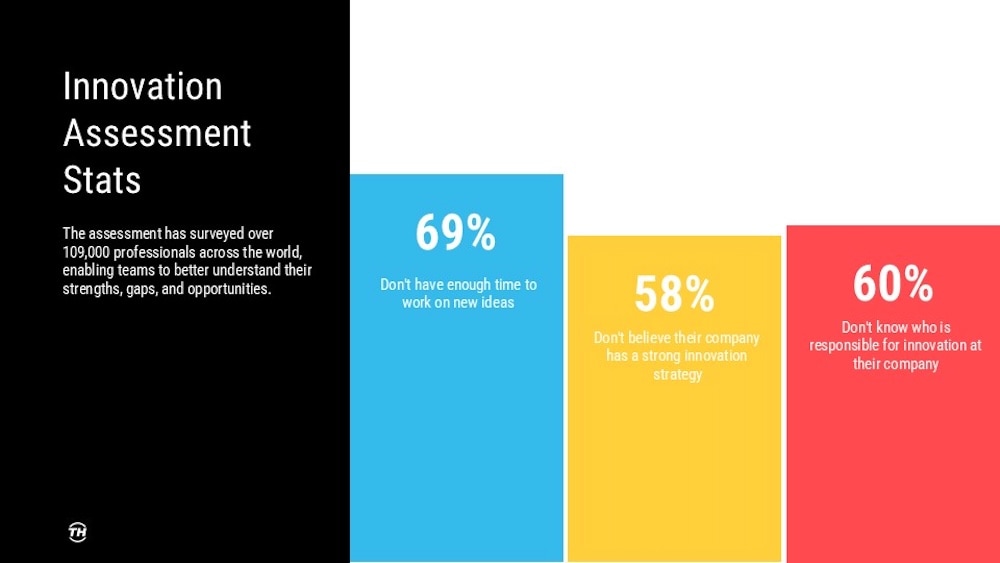
Data extracted from Trend Hunter’s Innovation Assessment
These numbers don’t point to a lack of ambition. They reveal a lack of structure, shared language, and aligned mindsets. Organizations want to innovate, but many struggle to do it consistently because they don’t fully understand how their people actually approach change.
Trend Hunter’s Innovation Assessment is designed to help individuals and teams understand their innovation mindset and unlock the behaviors required to create a real, durable innovation culture—so organizations can move faster from insight → idea → experiment → execution without creating chaos or burnout.
In under 10 minutes, the assessment helps you uncover:
- your innovation archetype (and what it means in real work)
- the traps that slow you down under pressure
- how you collaborate best—and where you clash with others
- what to do next to accelerate execution and innovation velocity
A Simple Framework: Farmer vs. Hunter
Trend Hunter’s Innovation Assessment is built on one foundational model: Farmers and Hunters. This model surfaces three core innovation instincts and three core innovation traps, revealing how people behave when they’re at their best, and what happens when pressure rises.
Farmers are loyal, consistent, and disciplined. They stabilize teams, protect quality, and help scale what works. But every strength comes with a risk: Farmers can become overly cautious, repetitive, or resistant to disruption.
Hunters are curious, insatiable, and willing to destroy what no longer serves the future. They spark breakthrough ideas, challenge assumptions, and push organizations forward. But unchecked, Hunters can become distracted, dissatisfied, or reckless—which creates chaos without adoption.
The point isn’t to judge one style as better than the other. Instead, it’s about understanding the instincts that power innovation and the traps that appear when those instincts go too far.
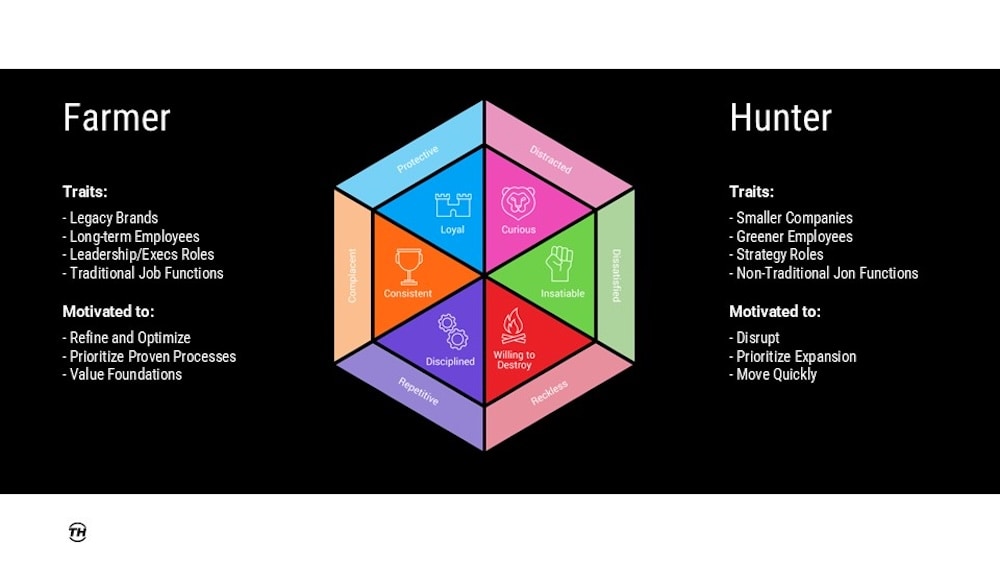
Trend Hunter’s Farmer/Hunter framework
Why Innovation Stalls (Even With Great Ideas)
The real reason innovation stalls is rarely a lack of creativity. It’s what happens inside real organizations every day:
- big ideas die because nobody owns them
- meetings feel chaotic to Farmers and blocked to Hunters
- teams optimize execution metrics while disruption accelerates outside the organization
Innovation thrives when Farmers and Hunters are in sync.
Hunter-heavy cultures often move fast but struggle with follow-through. Farmer-heavy cultures are stable and scalable, but often resist the disruption required for long-term growth. The most innovative organizations build teams that can do both: explore what’s next, and scale what works.
What the Innovation Assessment Is (and What You Get)
Trend Hunter’s Innovation Assessment is an online tool based on our work with 500+ of the world’s top brands and innovators.
Every participant receives:
- a defined innovation archetype
- a personalized report with 10+ pages of tailored recommendations
- insights into your strengths, blind spots, and growth opportunities
- clear actions to reduce friction and improve execution speed
Here’s what makes this so powerful: the assessment doesn’t just tell you what type of innovator you are, it shows you how to unlock momentum. For example, a Curious innovator often needs stronger prioritization systems to avoid distraction, while a Disciplined innovator often needs more experimentation permission to avoid perfectionism or rigidity.
Why Innovation Archetypes Work Better Than Generic Advice
Most innovation advice sounds like:
- “be more agile”
- “think outside the box”
- “fail faster”
The problem is that this advice is too broad to drive behavior change. Trend Hunter’s innovation archetypes work because they create a shared language for how people actually innovate and translate that into specific, practical guidance based on your natural style.
Trend Hunter’s framework includes 24 innovation archetypes, ranging from Rebellious Warden to Devil’s Advocate, built from six core instincts (and their traps):
- Disciplined (trap: repetitive)
- Curious (trap: distracted)
- Consistent (trap: complacent)
- Insatiable (trap: dissatisfied)
- Loyal (trap: protective)
- Willing to Destroy (trap: reckless)
These combinations reveal how someone spots opportunities, manages risk, collaborates, and executes, making innovation coaching far more personal, actionable, and useful than one-size-fits-all advice.
How to Use Your Archetype Report (In Real Work)
Your archetype report is designed to be practical, not theoretical. Leaders and innovators use it to:
- pitch ideas in ways that earn buy-in faster
- identify the trap that shows up when deadlines and pressure hit
- improve collaboration with opposite archetypes
- accelerate team execution by clarifying decision dynamics
Instead of trying to “be more innovative,” you get clear guidance on what to do more of, what to stop doing, and how to work smarter with others.
Archetype Collisions: Where Innovation Gets Stuck
Many innovation roadblocks are actually collaboration problems in disguise. Common collisions include:
- Curious vs. Disciplined: one pushes for possibilities, the other pushes for structure
- Willing to Destroy vs. Loyal: one drives disruption, the other protects what works
- Insatiable vs. Consistent: one raises ambition, the other preserves stability
When teams can name these dynamics, they reduce friction, improve trust, and move faster without burning out.
Innovation Isn’t One Skill, It’s a Team Sport
The most innovative organizations don’t hire only Hunters or only Farmers because archetype diversity is crucial to innovation. They build cultures with a mix of:
- Farmers (disciplined, consistent, loyal) who excel at execution and scale
- Hunters (curious, insatiable, willing to destroy) who excel at exploration and disruption
- Hybrids who translate between bold bets and operational realities
This mix matters because innovation requires both modes. Teams that over-index on exploration often generate ideas that never scale. Teams that over-index on execution can become extremely efficient at a business model that slowly becomes obsolete.
Archetype diversity also strengthens performance by increasing cognitive diversity; different thinking styles that improve problem-solving, reduce groupthink, and create a healthier risk balance. Hunters stretch the opportunity space, Farmers stress-test feasibility, and hybrids turn disruptive ideas into executable reality.
Team Innovation Is Where Growth Gets Unlocked
Individual results create awareness, but team results create acceleration. When teams complete the Innovation Assessment together, organizations gain a clear culture map showing:
- whether they over-index on protection or disruption
- where collaboration friction shows up in decision-making
- what archetype mix they have today—and what may be missing
- how to improve execution speed without burning people out
This is where innovation becomes scalable: not through more ideas, but through alignment, shared language, and repeatable behaviors.
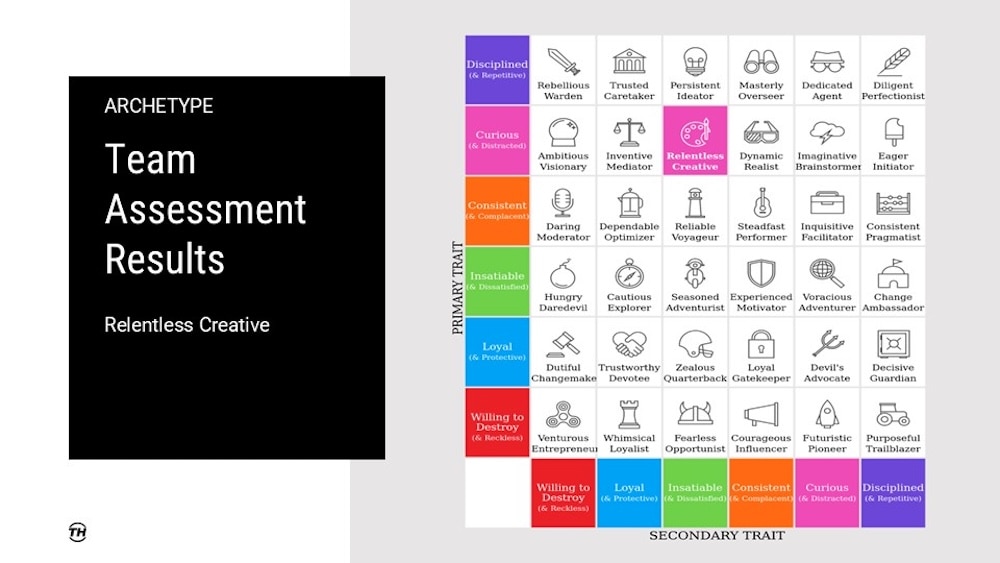
Example of a Team Assessment Archetype
Quick Innovation Accelerators (Based on Your Instincts)
Even before you take the assessment, here are practical ways to apply the instincts framework immediately:
- Disciplined: Don’t wait for the perfect plan—build a small test and learn faster
- Curious: Capture signals aggressively, but prioritize ruthlessly
- Consistent: Protect quality, but challenge one “untouchable” assumption each month
- Insatiable: Push for better—define “enough” so progress can land
- Loyal: Advocate for people and change—don’t let protection become gatekeeping
- Willing to Destroy: Disrupt strategically—validate before you detonate
Conclusion: A Faster Path to Innovation Culture
Innovation doesn’t scale through more brainstorming sessions. It scales through shared language, aligned behaviors, and teams that know how to move ideas forward together.
The Trend Hunter Innovation Assessment gives individuals and organizations a clear starting point: understanding how you’re wired to innovate and what to do next to accelerate momentum.
The assessment is free to take, and everyone is encouraged to try it: InnovationAssessment.com
Trend Hunter also offers follow-on services based on assessment results, including:
- guided team overviews
- customized workshops
- keynotes
- innovation accelerator programs
Tips for Taking the Assessment
- The assessment is designed to take 5–10 minutes; don’t overthink it. Go with your gut.
- It includes multiple choice, ranking questions, agree/disagree prompts, and “this or that” trade-offs. The structure is intentionally designed, so (again): don’t overthink it.
- Everyone is nuanced. The assessment won’t define your entire innovation persona, but it will act as a guide to help you lean into your strengths and adapt to potential hindrances (traps). As a rule of thumb: take what resonates with you and leave what doesn’t.
Because the fastest way to grow innovation capacity isn’t doing more. It’s understanding what’s already in your people and unlocking it.
For more information on the creating a culture of innovation, consider booking one of our custom masterclasses here: https://www.futuristu.com/custom-innovation-masterclass.